If you’re planning a SaaS product, one of the first questions you’ll probably ask is: how much will it cost to build?
The short answer is that SaaS development can range from around $10,000–$20,000 for a focused early-stage MVP to $100,000+ for a sophisticated, production-ready platform.
But those numbers only become useful when you understand what you’re actually comparing.
A SaaS product with one core workflow, basic authentication and simple subscription billing is very different from a multi-tenant platform with multiple user roles, advanced permissions, third-party integrations, AI functionality and complex reporting.
That’s why I prefer to look at SaaS development cost in terms of scope, complexity and the stage of the product rather than trying to attach one price to every SaaS idea.
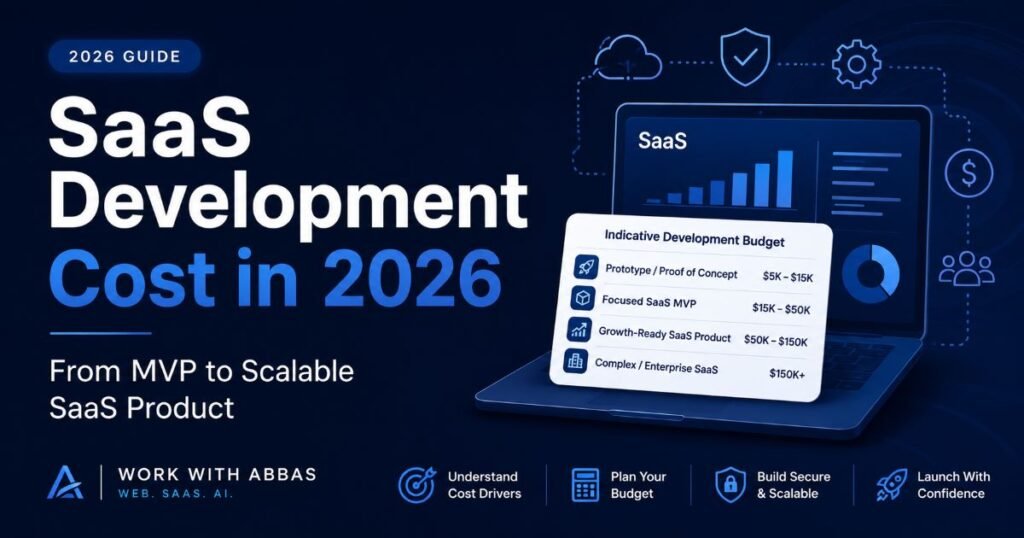
SaaS Development Cost at a Glance
For early planning, these broad ranges can help you understand where a project may sit:
| SaaS Project | Indicative Development Budget |
|---|---|
| Prototype / Proof of Concept | $5,000–$15,000 |
| Focused SaaS MVP | $15,000–$50,000 |
| Growth-Ready SaaS Product | $50,000–$150,000 |
| Complex / Enterprise SaaS | $150,000+ |
Note: These are indicative planning ranges rather than fixed quotes. Actual SaaS development costs vary significantly depending on product scope, architecture, integrations, security requirements, team structure and development approach. Published 2026 estimates also vary considerably across development providers.For additional market context, recent 2026 SaaS development cost analyses from UX Continuum and FNA Technology place a focused SaaS MVP broadly around the $15,000–$50,000 range, while more complex products can move significantly beyond that budget.
These are planning ranges, not fixed quotes. The actual cost depends heavily on what the product needs to do, how many users and roles it supports, how its data is structured, which systems it integrates with, and how much infrastructure needs to be ready from day one.
A carefully scoped $20,000 MVP can sometimes be a much better business decision than attempting to build a $100,000 product before validating whether customers actually want it.
What Determines the Cost of SaaS Development?
Two SaaS products that look similar from the outside can require completely different levels of development underneath.
Here are some of the biggest factors that affect the budget.
1. Features and Product Complexity
The number of screens isn’t necessarily what makes SaaS development expensive.
The underlying business logic matters more.
A simple dashboard displaying stored information is relatively straightforward. A dashboard that combines data from multiple systems, applies business rules, generates reports and changes what each user can access is considerably more complex.
Before estimating a SaaS product, I therefore look at what each feature actually needs to do, not simply how many features appear on a list.
2. User Roles and Permissions
A product with one type of user is generally simpler than a platform supporting:
-
- Customers
-
- Administrators
-
- Managers
-
- Employees
-
- Partners
-
- Vendors
-
- Different subscription levels
Each additional role can affect dashboards, permissions, workflows, notifications and data access.
Complex role-based access can therefore have a meaningful impact on SaaS development cost.
3. Multi-Tenant Architecture
Many SaaS products serve multiple customers or organizations through the same platform.
That introduces an important architectural requirement: one customer’s data must remain securely separated from another customer’s data while the application continues operating as a unified platform.
The appropriate architecture depends on the product, expected scale, security requirements and business model.
Making this decision correctly early in development can prevent expensive restructuring later.
4. Subscription and Billing
Recurring billing may sound like a simple feature, but SaaS billing can involve much more than connecting a payment gateway.
You may need:
-
- Monthly and annual plans
-
- Free trials
-
- Multiple pricing tiers
-
- Upgrades and downgrades
-
- Usage-based pricing
-
- Coupons
-
- Failed-payment handling
-
- Tax calculations
-
- Cancellation rules
-
- Billing history
-
- Account restrictions based on subscription status
A straightforward subscription model is relatively manageable. Complex billing logic can become a significant system of its own.
5. Third-Party Integrations
Your SaaS product may need to communicate with:
-
- Payment platforms
-
- CRM systems
-
- Accounting software
-
- Email services
-
- SMS providers
-
- Analytics platforms
-
- Cloud storage
-
- Mapping services
-
- External databases
-
- Other business applications
Each integration introduces its own API, authentication method, limitations and potential failure scenarios.
The more deeply your SaaS product depends on external systems, the more development and testing those integrations generally require.
6. UX and UI Design
Good SaaS design isn’t only about making the interface attractive.
Users need to understand what to do, where to go and how to complete important workflows without unnecessary friction.
Complex dashboards, onboarding processes, settings, reporting tools and multi-step workflows require thoughtful UX planning before development begins.
Investing in those decisions early can actually reduce development cost by preventing expensive changes after the product has already been built.
7. AI Features
Adding AI can range from relatively straightforward API integration to a much more sophisticated AI system.
For example, a product might use AI for:
-
- Content generation
-
- Summarization
-
- Document processing
-
- Recommendations
-
- Customer assistance
-
- Data extraction
-
- Classification
-
- Internal knowledge search
-
- Workflow automation
The development cost depends on what the AI feature needs to accomplish, what information it can access, how reliable its output must be and how deeply it connects with the rest of the application.
8. Security and Compliance
Every SaaS product needs appropriate security, but some industries require significantly more.
Depending on the product, this can involve stronger authentication, audit logs, encryption, data-retention controls, access policies, security testing or specific regulatory requirements.
These requirements should be identified during planning rather than added as an afterthought.
9. Scalability and Infrastructure
A product being tested by 50 early users has different infrastructure requirements from one serving thousands of organizations.
That doesn’t mean every MVP should be engineered for millions of users from day one.
It means the architecture should support the realistic next stages of the business without creating unnecessary complexity before it is needed.
How Much Does a SaaS MVP Cost?
A focused custom SaaS MVP can often fall somewhere around $15,000–$50,000, although simpler validation products may cost less and feature-heavy MVPs can cost considerably more.
The important word here is focused.
An MVP isn’t supposed to contain every feature you eventually want.
Its purpose is to deliver enough value to test the central business assumption behind the product.
For example, a B2B SaaS MVP might initially include:
-
- User registration and authentication
-
- One or two user roles
-
- A core business workflow
-
- A dashboard
-
- Basic administration
-
- Subscription billing
-
- One important integration
-
- Essential notifications
Features such as advanced analytics, numerous integrations, complex automation, native mobile applications and extensive customization might be introduced after the core product has been validated.
If you’re still deciding what the first version of your product should include, my SaaS MVP Development Guide explains how to define the core scope, prioritize essential features and avoid overbuilding before launch.
Example: A Focused B2B SaaS MVP
Imagine you’re building a platform that helps small businesses manage a particular operational process.
The first version needs:
-
- Business registration
-
- Employee accounts
-
- Two permission levels
-
- A central dashboard
-
- One core workflow
-
- Document uploads
-
- Email notifications
-
- Stripe subscriptions
-
- Basic reporting
-
- Admin controls
That could potentially fit within a focused MVP scope.
Now imagine adding:
-
- Five user roles
-
- Custom workflows for every customer
-
- Real-time collaboration
-
- AI document analysis
-
- Accounting integration
-
- CRM integration
-
- Advanced analytics
-
- Mobile applications
-
- Enterprise SSO
-
- Detailed audit logs
It’s still the same SaaS idea, but it is no longer the same development project.
This is why comparing quotes without comparing scope can be misleading.
SaaS Development Cost by Project Stage
Another useful way to understand the budget is to look at where the money goes.
Discovery and Product Planning
Before development starts, the idea needs to become a clearly defined product.
This stage can include:
-
- Business requirements
-
- User types
-
- Core workflows
-
- MVP definition
-
- Technical requirements
-
- Integration planning
-
- Product roadmap
Good discovery helps answer one of the most valuable questions in software development:
What should we not build yet?
UX and UI Design
The product’s workflows are translated into screens and interactions.
For SaaS products, this can include dashboards, onboarding, account management, administration, billing and the main product workflow.
Development
This is typically the largest portion of the budget.
It includes frontend development, backend development, databases, authentication, business logic, integrations and infrastructure.
Testing and Quality Assurance
The application needs to be tested across important workflows, user roles, devices and edge cases.
Testing becomes increasingly important as the number of roles, integrations and business rules grows.
Deployment and Launch
The product is configured for its production environment, databases and infrastructure are prepared, and the first live version is released.
Ongoing Development
Launching a SaaS product isn’t the end of development.
Real users will reveal what works, what creates friction and which features actually matter.
A sensible budget therefore leaves room for improvement after launch.
Hidden SaaS Costs You Should Budget For
The development quote isn’t necessarily the complete cost of operating the product.
Depending on your SaaS, you may also need to budget for:
Cloud Hosting
Infrastructure costs usually increase as usage, storage and processing requirements grow.
Payment Processing
Payment providers generally charge transaction fees, and more advanced subscription-management services may have additional costs.
Email and SMS
Transactional emails, verification messages, notifications and SMS services may be priced according to usage.
Third-Party APIs
Some integrations charge monthly fees or usage-based fees.
AI API Usage
If your SaaS relies on external AI models, ongoing AI usage can become an operational cost that should be considered when designing your own pricing model.
Monitoring and Analytics
Error tracking, application monitoring, product analytics and other operational tools may carry recurring costs.
Maintenance and Improvements
Operating systems, frameworks, APIs and customer requirements change.
A healthy SaaS product needs ongoing maintenance as well as continued product development.
Freelancer vs Agency vs In-House SaaS Development
Who builds the product can affect both cost and the way the project operates.
Freelancer or Independent Consultant
Working directly with an experienced independent professional can provide:
-
- Direct communication
-
- Fewer management layers
-
- Flexible collaboration
-
- Strong continuity between planning and execution
This model can work particularly well for founders and businesses that want close involvement with the person responsible for shaping the solution.
The limitation is capacity. A single specialist may need additional development or design resources for particularly large products.
Development Agency
An agency can provide a larger team containing multiple specialists and may be appropriate when a project requires several disciplines working simultaneously.
The trade-off can be higher overhead and additional layers between the client and the people doing the work.
In-House Team
Building internally provides maximum long-term control and deep product knowledge.
It can make sense for established SaaS companies where software development is an ongoing core business function.
However, recruitment, salaries, management and retaining specialized talent can make it the most significant long-term commitment.
There is no universally best model.
The right choice depends on your product, budget, timeline and how much development capability you need after launch.
How to Reduce SaaS Development Cost Without Building the Wrong Product
Reducing cost shouldn’t mean choosing the cheapest possible technology or cutting quality from important parts of the application.
The better approach is to reduce unnecessary scope.
Start With the Core Problem
Ask what users absolutely need the product to solve.
Build that workflow exceptionally well before adding secondary features.
Prioritize Features
Separate features into:
Must have
Should have
Could have
Later
This simple exercise can dramatically change an MVP budget.
Validate Workflows Before Development
Changing a workflow during planning is inexpensive.
Changing it after frontend, backend, database and integration work has been completed is not.
Use Established Services Where Appropriate
Authentication, payments, email, cloud infrastructure and other common requirements often don’t need to be reinvented.
Using reliable existing services can reduce development time while allowing more attention to be spent on the parts of your SaaS that actually differentiate the product.
Plan Integrations Early
If your product depends heavily on another platform, investigate its API before development begins.
Discovering important limitations halfway through development can create expensive changes.
Build for Realistic Growth
Your MVP doesn’t need infrastructure designed for millions of users if you’re currently trying to acquire the first hundred.
At the same time, short-term decisions shouldn’t make the next stage unnecessarily difficult.
The goal is appropriate scalability, not maximum complexity.
Is Custom SaaS Development Worth the Investment?
Custom SaaS development makes sense when the product itself is part of the business model.
Unlike off-the-shelf software, a custom SaaS product gives you control over:
-
- Features
-
- User experience
-
- Pricing model
-
- Business logic
-
- Integrations
-
- Data
-
- Product roadmap
But custom development also requires a larger initial investment and ongoing responsibility for the product.
That’s why I recommend defining the business problem and the first meaningful version before deciding how much software to build.
If you’re currently planning a SaaS idea, my SaaS Development Services are focused on turning that idea into a practical product roadmap and building the right first version without unnecessary complexity.
Frequently Asked Questions
How much does it cost to build a SaaS MVP?
A focused custom SaaS MVP can often fall in the $15,000–$50,000 range, although simpler validation products may cost less and complex multi-tenant or integration-heavy MVPs can cost significantly more.
How long does it take to build a SaaS product?
A focused MVP may take several weeks to a few months, while larger SaaS products can require several months or ongoing phased development. The timeline depends primarily on scope, complexity, integrations and how quickly product decisions can be made.
What makes SaaS development expensive?
Major cost drivers include complex business logic, multiple user roles, multi-tenant architecture, subscription billing, third-party integrations, AI features, security requirements and extensive reporting or automation.
How much does it cost to maintain a SaaS application?
There isn’t one standard maintenance percentage that applies to every SaaS product. Ongoing costs can include hosting, third-party services, monitoring, bug fixes, security updates and continued feature development.
Is custom SaaS more expensive than off-the-shelf software?
Initially, usually yes. Off-the-shelf software spreads its development cost across many customers. Custom SaaS development is justified when you need unique functionality, control over the product, a proprietary business model or capabilities existing software cannot provide.
Can I build my SaaS product in phases?
Yes — and in many cases, that’s the better approach. Start with the smallest version capable of delivering and validating the core value proposition, then use real customer feedback to determine what should be built next.