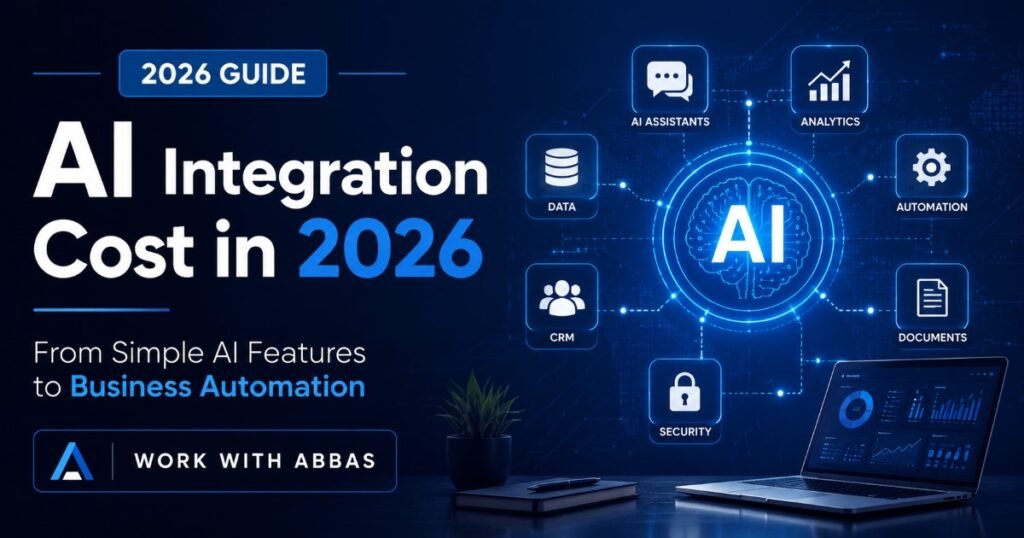
AI is becoming easier to access, but successfully integrating it into a real business is a very different challenge from simply subscribing to an AI tool.
If you’re considering adding AI to your website, SaaS platform, internal systems or business workflows in 2026, one of the first questions is likely to be: how much does AI integration cost?
The answer depends heavily on what you want AI to do.
A focused AI feature connected to an existing system may require a relatively modest investment. An intelligent assistant that understands company documents, automates workflows and connects with multiple business systems can require considerably more planning, development and infrastructure.
The important question isn’t simply how much AI costs. It’s which AI capabilities can create enough business value to justify the investment.
AI Integration Cost at a Glance
The following ranges provide a practical starting point for planning an AI integration project in 2026.
| AI Integration Type | Indicative Development Cost |
|---|---|
| Simple AI Feature or API Integration | $3,000–$10,000 |
| AI Assistant or Focused Automation | $10,000–$30,000 |
| Advanced AI Workflow Integration | $30,000–$75,000 |
| Complex / Enterprise AI Integration | $75,000+ |
Note: These are indicative planning ranges rather than fixed quotations. AI integration cost can vary considerably depending on the existing system, data requirements, integrations, security, workflow complexity and the AI models being used.
For additional market context, published 2026 AI implementation estimates vary considerably by scope and delivery model. SummationWorks places simple chatbot projects around $3,000–$12,000, LLM assistants around $8,000–$25,000 and workflow automation around $25,000–$80,000, while Mars Innovation estimates more advanced AI assistants and workflow automation substantially higher as integration complexity increases.
A business adding one focused AI capability to an existing application is fundamentally different from an organization introducing AI across multiple departments, databases and operational systems.
What Determines AI Integration Cost?
Two businesses may both say they want to “integrate AI” while actually requiring completely different solutions.
Several factors have the greatest impact on the final budget.
1. The Problem AI Needs to Solve
The first cost driver isn’t the AI model. It’s the business problem.
For example, AI could be used to:
- answer customer questions
- summarize documents
- categorize enquiries
- extract information from files
- qualify leads
- generate reports
- assist employees
- search internal knowledge
- automate repetitive workflows
- analyze business data
- add intelligent features to an existing application
A narrowly defined task is generally much easier to implement than an AI system expected to perform several connected business functions.
The clearer the problem, the easier it becomes to control development cost.
2. Existing Systems and Infrastructure
Integrating AI into an existing business often means connecting it with systems that are already in use.
These might include:
- websites
- SaaS platforms
- CRM systems
- ERP software
- databases
- customer portals
- e-commerce platforms
- document repositories
- internal applications
- communication tools
If these systems provide reliable APIs and structured data, integration can be relatively straightforward.
Legacy systems, fragmented data and poorly documented software can significantly increase development effort.
3. AI Model and API Requirements
Not every AI integration requires building or training a model from scratch.
Many practical business applications can use existing AI models through APIs and build the business logic, security, workflows and user experience around them.
The right approach depends on the task.
A project may use a hosted AI model, specialized AI service, open-source model or a combination of technologies.
The development decision should be based on accuracy, privacy, reliability, performance and cost rather than simply choosing the most powerful model available.
4. Data Preparation
AI systems are only as useful as the information they can access.
Business data may need to be:
- collected
- cleaned
- structured
- categorized
- converted
- indexed
- permissioned
- connected to existing databases
This can become a significant part of the project.
A company with organized documentation and structured databases is generally easier to integrate with AI than one whose information is spread across spreadsheets, emails, PDFs and disconnected systems.
5. Workflow Automation
AI becomes particularly valuable when it does more than generate text.
For example, an AI system might:
- receive a customer enquiry
- identify the customer’s intent
- retrieve relevant account information
- generate an appropriate response
- update the CRM
- create a follow-up task
- notify the responsible employee
That is no longer a simple chatbot.
It is an AI-powered business workflow, and the integration work surrounding the AI often becomes more important than the model itself.
6. Knowledge and Document Integration
Many businesses want an AI assistant that can answer questions using their own information rather than relying only on a general-purpose model.
The system may need access to:
- company policies
- product documentation
- contracts
- manuals
- support articles
- internal procedures
- training materials
- customer information
Building a reliable knowledge system requires document processing, retrieval, permissions and safeguards to ensure users receive relevant information.
The larger and more sensitive the knowledge base becomes, the more carefully the architecture needs to be designed.
7. Security and Permissions
An internal AI assistant should not automatically have access to everything in the organization.
Different employees may require different levels of access.
For example:
- sales staff may access customer information
- HR staff may access employee documents
- managers may access operational reports
- customers may only access their own information
AI systems therefore need to respect the same authentication, authorization and privacy rules as the underlying business software.
This becomes especially important when integrating AI into applications containing confidential or regulated data.
8. Testing and Reliability
AI output is probabilistic.
Traditional software can often be tested by checking whether a specific input produces an expected result. AI systems require additional evaluation because responses may vary.
Testing may include:
- response accuracy
- hallucination handling
- prompt injection resistance
- permission boundaries
- inappropriate responses
- workflow failures
- API failures
- model availability
- unusual user inputs
- human escalation
Production AI systems therefore require considerably more than connecting an API and displaying the response.
How Much Does a Simple AI Integration Cost?
A narrowly scoped AI integration may cost approximately $3,000–$10,000.
Examples could include:
- adding AI-generated summaries to an existing application
- classifying customer enquiries
- generating structured content
- extracting information from documents
- integrating an existing AI API
- adding a simple AI-powered feature to a website or internal tool
These projects work best when the business problem is clearly defined and the existing application already provides most of the required infrastructure.
The goal should be to solve one useful problem well rather than adding AI simply because the technology is available.
How Much Does an AI Assistant Cost?
A more capable business AI assistant may fall around $10,000–$30,000, depending on its responsibilities.
For example, an internal assistant might:
- authenticate employees
- search company documentation
- answer internal questions
- summarize information
- retrieve customer records
- generate drafts
- provide links to source documents
- maintain conversation context
- escalate questions it cannot answer
A customer-facing assistant may also need:
- website integration
- CRM connectivity
- lead capture
- conversation history
- human handoff
- analytics
- usage controls
- safety rules
The interface may look like a chatbot, but much of the real development effort happens behind the chat window.
How Much Does AI Workflow Automation Cost?
AI workflow automation often falls into the $30,000–$75,000 range when multiple systems and business processes are involved.
Consider a sales enquiry workflow.
Instead of simply answering a message, AI could:
- analyze the enquiry
- determine the requested service
- extract contact information
- score the opportunity
- check existing CRM records
- create or update the lead
- prepare a suggested response
- assign the opportunity
- schedule a follow-up
- notify the sales team
The value comes from connecting intelligence with actions.
This is why AI automation projects should be designed around workflows rather than isolated prompts.
When Can AI Integration Cost $75,000 or More?
Larger AI projects can move beyond $75,000 and, in enterprise environments, considerably higher.
This can happen when the system requires:
- multiple AI workflows
- large knowledge repositories
- complex user permissions
- several business-system integrations
- custom administration tools
- high-volume processing
- advanced analytics
- model evaluation
- private infrastructure
- strict security requirements
- audit trails
- multi-department deployment
- human approval workflows
- ongoing monitoring
At this level, AI becomes part of the organization’s broader technology architecture rather than a standalone feature.
AI API Integration vs Custom AI Development
One of the biggest misconceptions around AI development is that every business needs to build its own AI model.
Usually, it doesn’t.
AI API Integration
Using existing AI models through APIs can significantly reduce the time and investment required to launch useful AI capabilities.
The development work focuses on:
- application integration
- prompts and instructions
- business logic
- data retrieval
- permissions
- workflows
- user experience
- monitoring
- safeguards
For many businesses, this is the most practical starting point.
Custom AI Development
Custom development becomes more relevant when existing models cannot adequately handle the required task or when the business has specialized requirements around data, performance, deployment or control.
This can involve:
- custom model development
- fine-tuning
- specialized machine-learning pipelines
- private model deployment
- proprietary datasets
- advanced evaluation infrastructure
These projects generally require substantially more investment and specialized expertise.
The important decision is not whether custom AI sounds more sophisticated. It’s whether the additional complexity creates enough business value to justify it.
What Are the Ongoing Costs of AI Integration?
Development isn’t necessarily the final AI expense.
A production system can have recurring operating costs.
AI API Usage
Many AI providers charge based on usage.
Costs can depend on:
- number of requests
- amount of text processed
- model selected
- images or audio processed
- cached information
- response size
For a low-volume internal tool, these costs may be relatively small.
For a customer-facing application processing thousands or millions of requests, usage needs to be modeled carefully.
Hosting and Infrastructure
AI integrations may require additional infrastructure for:
- application hosting
- databases
- vector storage
- file processing
- queues
- background jobs
- caching
- monitoring
Infrastructure should scale with actual usage rather than being unnecessarily over-engineered from day one.
Third-Party Services
An AI workflow may connect with other paid platforms such as:
- CRM software
- email services
- messaging platforms
- document storage
- search systems
- analytics tools
- automation services
Their subscription or API costs should be included when calculating total ownership cost.
Monitoring and Maintenance
AI integrations should be monitored after launch.
Models change, APIs evolve, business processes change and users discover new ways to interact with the system.
Ongoing work may include:
- improving instructions
- reviewing inaccurate responses
- updating knowledge sources
- adjusting workflows
- managing model changes
- improving safeguards
- reducing API costs
- adding new capabilities
How to Reduce AI Integration Cost
The easiest way to waste money on AI is to begin with technology instead of the business problem.
A few decisions can dramatically improve the economics of a project.
Start With One High-Value Use Case
Don’t begin with:
“We need AI.”
Begin with something measurable, such as:
“We spend 40 hours every week manually categorizing and responding to customer enquiries.”
Now there is a problem that can be evaluated.
Use Existing Models Where Appropriate
Building a model from scratch is unnecessary for many business applications.
Existing AI services can often provide the intelligence while custom development handles the business-specific workflow.
Integrate Before Replacing
You may not need to replace your CRM, website, ERP or internal software.
Adding an AI layer to existing systems can sometimes create significant value without rebuilding the underlying technology.
Keep Humans in Important Decisions
Not every decision should be fully automated.
For high-impact actions, AI can prepare information or recommend an action while a person remains responsible for approval.
This can reduce complexity and risk while still delivering meaningful productivity improvements.
Measure the Result
AI should eventually improve something measurable.
That might be:
- response time
- support workload
- processing time
- lead conversion
- employee productivity
- data-entry effort
- customer satisfaction
- operational cost
Without a measurable outcome, it becomes difficult to know whether the AI investment is actually working.
Example: AI Integration for Customer Enquiries
Imagine a business receives hundreds of enquiries through its website and email every week.
Employees currently read each message, identify what the customer needs, enter the information into a CRM and assign it to the appropriate team member.
A focused AI integration could:
- capture the enquiry
- identify intent
- extract relevant information
- categorize the request
- check the CRM
- create or update the customer record
- prepare a suggested response
- assign the enquiry
- notify the responsible employee
A human can still approve the response before anything is sent.
This is a good example of practical AI integration because the goal isn’t to replace employees.
The goal is to eliminate repetitive steps so employees can spend more time on work that actually requires their judgment.
Is AI Integration Worth the Investment?
AI integration can be worthwhile when it solves a repetitive, expensive or difficult business problem.
It becomes much harder to justify when the project begins with the technology rather than a clear use case.
Before investing, ask:
- What process are we improving?
- How much time does it currently consume?
- How frequently does it happen?
- What does the existing process cost?
- What would successful automation save?
- What happens when AI makes a mistake?
- Does a human need to approve the result?
- Can the outcome be measured?
The best AI projects aren’t necessarily the ones using the most advanced models.
They’re the ones where technology produces a clear operational or customer benefit.
If you’re exploring how AI could connect with your existing website, application or business workflows, my AI Integration Services focus on practical integrations designed around real business problems, existing systems and measurable outcomes.
Frequently Asked Questions
How much does AI integration cost in 2026?
A simple AI feature or API integration may cost around $3,000–$10,000, while AI assistants and focused automation projects may fall around $10,000–$30,000. More advanced workflow integrations can reach $30,000–$75,000, with complex enterprise projects exceeding $75,000.
How much does it cost to integrate AI into an existing application?
The cost depends on the existing application’s architecture, the AI capability being added, required data access and the number of external systems involved. A focused feature can be relatively inexpensive compared with rebuilding an application around AI.
Do I need to build my own AI model?
Usually not. Many business use cases can use existing AI models through APIs while custom development handles the workflows, data, permissions and user experience.
How much does an AI chatbot cost?
A basic chatbot can be relatively inexpensive, while a business assistant connected to company data, CRM systems, user accounts and operational workflows requires considerably more development.
What is the biggest cost in AI integration?
The AI model itself isn’t always the biggest expense. Integrating business systems, preparing data, building workflows, implementing permissions, testing reliability and creating the surrounding application can represent a larger portion of the project.
Are there monthly costs after an AI integration is launched?
Usually yes. Depending on the solution, recurring costs can include AI API usage, hosting, databases, storage, third-party services, monitoring and ongoing maintenance.
Can AI integrate with my existing CRM or business software?
Often yes, provided the software offers an API or another reliable integration method. AI can potentially work alongside CRM, ERP, e-commerce, support, communication and internal business systems.
Should a small business invest in AI integration?
It can make sense when there is a specific repetitive process where automation can save enough time or improve results to justify the investment. Starting with one focused, measurable use case is usually better than attempting a large AI transformation immediately.